
Z31/ECUdifferences
Imported page. This page was converted from an archived copy of "Z31 Fuel Injector Differences, ECU and O2 sensor and Interchange Information" (Xenonzcar, fetched 2026-05-15). The conversion was mechanical, so tables, links and formatting may contain conversion artefacts. Compare against the archived copy if something looks wrong. The content belongs to its original authors.
Z31 Fuel Injector Differences, ECU and O2 sensor and Interchange Information[edit]
This information has been put together for ECU/injector/O2 sensor interchange information. This should be particularly useful for those swapping an 88-89 ECU into their car. As these are the only major differences in the Z31's stock engine management, this should be what you need to figure out if a particular configuration will work for you.
Fuel Injector /xenonzcar_archive/z31/images[edit]
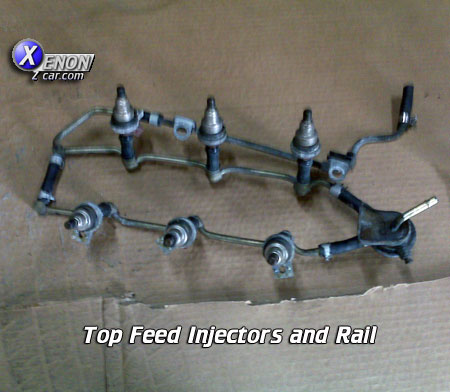
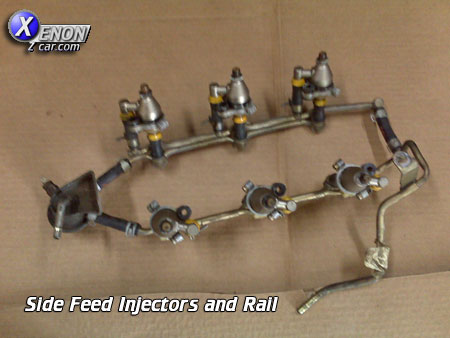
Interchange Information[edit]
Z31 engine control computer system (ECCS), o2 sensor, and fuel injector interchange information
There is absolutely no difference between a regular 88 Turbo ECU and an "88SS" ECU. There is nothing special about a ECU branded "88 Shiro" or otherwise, it's a marketing ploy to make it SEEM more desirable.
All NA injectors are ~180cc/min and all Turbo injectors are ~260cc/min, the ECUs are programmed accordingly.
High impedance ECU on a low impedance injector will require installing six 6 to 10ohm 10W dropping resistors to keep from frying the injector driver units. If dropping resistors are to be installed, the fuel injectors must be wired back to the factory (pre-service campaign) wiring
Low impedance ECU driving a high impedance injector should operate normally.
Feed type does not matter to the ECU as impedance and flow rating do, however the lower intake manifolds are different and will require shaving/shimming the injector mounting area for fitment if your engine came with the other type of rails/injectors.
Titania-type oxygen sensors are not compatible with zirconium type, and vise versa. Zirconium sensors relay a 0-1v signal and Titania sensors vary resistance to give the ECU its mixture feedback data. If you wanted to switch sensors to accommodate a 86-89T ECU, the wiring in the engine wiring harness would need to be changed, as well as the oxygen sensor bung (Titania are 17MM and Zirconium are 22MM).
CALifornia and FEDeral ECUs can interchange. The only known physical difference in the CAL version is the presence of an EGT sensor.
The PROM chip on 88-89 NA and turbo ECUs can be swapped. That is, if you want an 88-89 ECU and would like to use a Zirconium type oxygen sensor you can put the turbo PROM in the NA ECU. This should save a lot of time in swapping out the sensor bung, sensor, and re-wiring. Hence, the desirable unit for 84-85T cars would be an 88-89NA ECU, and the desirable unit for 86-89T cars would be the 88-89T ECU.
The Turbo ECU has a daughter-board for the detonation sensor, Non-turbos do not. (Note: the TP/RPM feedback region for the detonation sensor is very small, it is not even used under boost or at any time above 3000RPM.)
The Turbo and Non-turbo cars do not use the same type of idle control. The wiring in the engine harness is also different for these controls. Not really an issue: I, and many others have perfectly running cars with all idle control devices removed.
88-89 Turbo ECUs have a timing map that runs more timing under boost on account of the smaller (T25) turbocharger only running 4-5PSI boost pressure. Keep this in mind if swapping.
84-85 ECUs (all) have been reported to have a small lean surge problem during the first 30 seconds or so of engine warm up. This is most likely an issue with the cold-start enrichment and can be remedied by switching from CHTS to FTS signal during startup.
ECCU lookup[edit]
To Lookup your ecu or interchange for ECU,O2, Fuel Injectors, Complete one of the search boxes and click submit. Only one search below can be run at a time.
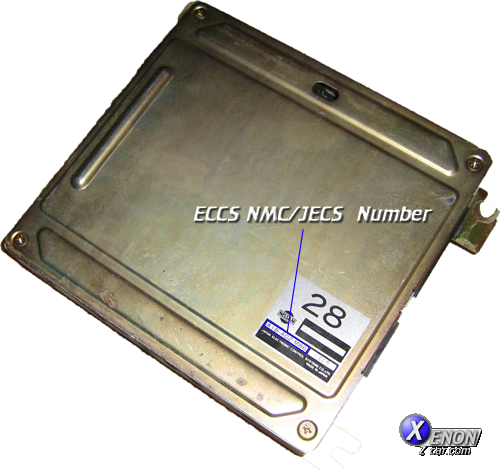
ECU can have a NMC number or a JECS number the numbers are listed as NMC/JECS these are interchangeable.
Non USDM ECUs[edit]
If your ECU is not listed above you will have a Euro Or JDM ECU.
Below is a chart of these ECUs
If it has an alternate part number, that means the part interchanges between the two and vice versa.
These numbers are strictly pulled from the Euro and JDM FAST parts catalogs. It does not list the JECS number, only the Nissan part number.
- 23710- is the first part of the part number for all factory ECUs.
- 2371M- indicates Nissan remanufactured part number.
- END means the end of the model run.
- ??? means FAST does not specify which transmission combination.
JDM Z31 ECU part numbers[edit]
| Part Number | Date Range | Engine | Transmission | Alt Part Number |
| 12P01 | 9/83 - 10/86 | VG20ET | 5 speed manual | N/A |
| 12P11 | 9/83 - 10/86 | VG20ET | Automatic | N/A |
| 15P00 | 9/83 - 10/86 | VG30ET | 5 speed manual | N/A |
| 15P10 | 9/83 - 10/86 | VG30ET | Automatic | N/A |
| 20P01 | 10/85 - 10/86 | RB20DET | ??? | N/A |
| 20P60 | 10/86 - 7/87 | RB20DET | 5 speed manual | 20P61 |
| 20P61 | 7/87 - END | RB20DET | 5 speed manual | N/A |
| 20P70 | 10/86 - 8/87 | RB20DET | Automatic | 20P71 |
| 20P71 | 8/87 - END | RB20DET | Automatic | N/A |
| 22P00 | 10/86 - 7/87 | VG30DE | 5 speed manual | 22P01 |
| 22P01 | 7/87 - END | VG30DE | 5 speed manual | N/A |
| 22P10 | 10/86 - 8/87 | VG30DE | Automatic | 22P11 |
| 22P11 | 8/87 - END | VG30DE | Automatic | N/A |
| 22P72 | 10/86 - END | VG30ET | Automatic | N/A |
EURO Z31 ECU part numbers[edit]
| Part Number | Date Range | Engine | Transmission | Alt Part Number | Country |
| 06P00 | 1/84 - 7/85 | VG30E | 5 Speed Manual | 06P01 | N/A |
| 06P01 | 7/85 - END | VG30E | 5 Speed Manual | N/A | N/A |
| 06P05 | 1/84 - 7/85 | VG30E | 5 Speed Manual | N/A | Switzerland/Sweden |
| 06P06 | 7/85 - 2/87 | VG30E | 5 Speed Manual | N/A | Switzerland/Sweden |
| 06P10 | 1/84 - 7/85 | VG30E | Automatic | 06P11 | N/A |
| 06P11 | 7/85 - END | VG30E | Automatic | N/A | N/A |
| 06P16 | 7/85 - 2/87 | VG30E | Automatic | N/A | Switzerland/Sweden w/anti-pollution controls |
| 07P00 | 1/84 - END | VG30ET | ??? | N/A | NOTE 1 |
| 23P00 | 2/87 - END | VG30ET | ??? | N/A | NOTE 2 |
- NOTE 1 - for Europe except West Germany, Holland, Switzerland, and Austria
- NOTE 2 - for West Germany, Holland, Switzerland, and Austria
Europe had different emission standards for different countries at the time, hence the difference in part numbers for countries
Sources used on this page:[edit]
- 1984-1988 Nissan 300ZX Factory Service Manual
- Z31 parts Fiche
- redz31.net
- Euro and JDM ECU part numbers researched by: NissanEgg of Z31performance.com