
S30/transmissions php
Imported page. This page was converted from an archived copy of "S30 Transmission Differences" (Xenonzcar, fetched 2026-05-15). The conversion was mechanical, so tables, links and formatting may contain conversion artefacts. Compare against the archived copy if something looks wrong. The content belongs to its original authors.
S30 Transmission Differences[edit]
Manual Transmissions[edit]
Datsun/Nissan offered several 4- and 5-speed manual transmissions for the first-generation Z cars. While a European 5-speed was available for the 240Z, it was rarely seen in the US market. It wasn’t until 1977 that a 5-speed became part of the US Z-car lineup.
The 1977–1978 5-speed is a wide-ratio transmission, meaning the gear spacing is further apart. In contrast, the 1981–1983 280ZX came with a close-ratio five-speed transmission, preferred for road racing because it keeps the rev range tighter between shifts.
Choosing the “optimum” transmission depends on your driving goals. For most owners, the best option is often the one already in the car. However, if you upgrade your 240Z, 260Z, or 280Z to a 3.90 or higher rear-end ratio, consider a 5-speed swap for improved highway cruising.
Manual Transmission Gear Ratios[edit]
| Gear Ratio / Model Year | 240Z 1970–1973 |
260Z 1974 |
280Z 1975–1976 |
280Z 1977–1978 |
|---|---|---|---|---|
| 1st | 3.549 | 3.592 | 3.321 | 3.321 |
| 2nd | 2.197 | 2.246 | 2.077 | 2.077 |
| 3rd | 1.420 | 1.415 | 1.308 | 1.308 |
| 4th | 1.000 | 1.000 | 1.000 | 1.000 |
| 5th | — | — | — | 0.864 |
Automatic Transmissions[edit]
In 1971, Datsun introduced an automatic transmission option for the S30 series Z-car. The model used was the 3-speed 3N71B. This fully automatic unit features a 3-element hydraulic torque converter, two planetary gear sets, two multiple-disk clutches, a multiple-disk brake, a band brake, and a one-way sprag clutch.
Gear changes are fully automatic based on vehicle speed and engine torque input. The transmission continuously receives signals from car speed and engine manifold vacuum to determine the proper gear ratio, ensuring maximum efficiency and performance at all throttle positions.
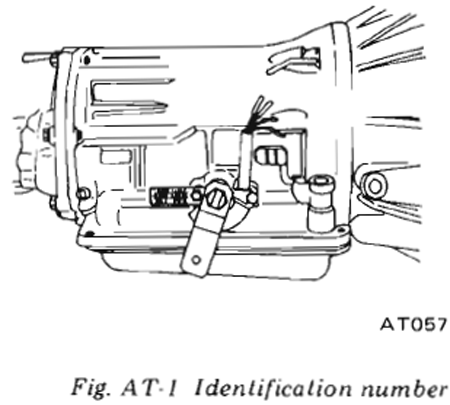
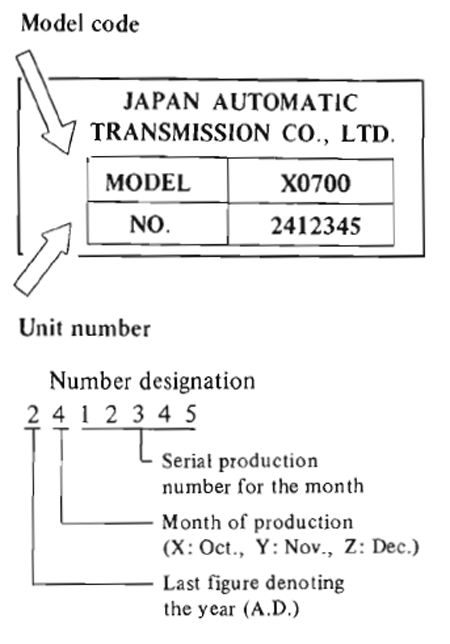
Below are details on identifying and reading the ID plate for this automatic unit.
Sources Used[edit]
- Written by: John Walker