
Z31/Brakebleeding php: Difference between revisions
m XenonzcarImporter moved page Sites/Xenonzcar/z31/Brakebleeding php to Z31/Brakebleeding php without leaving a redirect: Flatten Sites/ namespace; provenance preserved via ImportedFrom banner |
CleanupBot (talk | contribs) Rewrite 5 dev.z31library.com link(s) to z31library.com |
||
| (2 intermediate revisions by 2 users not shown) | |||
| Line 1: | Line 1: | ||
{{ImportedFrom|site=Xenonzcar|title=Bleeding your Z31 brake system the right way|url= | {{ImportedFrom|site=Xenonzcar|title=Bleeding your Z31 brake system the right way|url=https://z31library.com/xenonzcar_archive/z31/Brakebleeding.php.html|archive=https://z31library.com/xenonzcar_archive/z31/Brakebleeding.php.html|fetched=2026-05-15}} | ||
== Bleeding your Z31 brake system the right way == | == Bleeding your Z31 brake system the right way == | ||
Any time you remove a part of you brake system (Master cylinder, Caliper) or the system develops a leak, or if the fluid in the master cylinder runs low, Air will enter the system. To remove this air the system must be bleed. If the Master cylinder was removed or fluid in the master cylinder runs low a complete bleeding of the system will be needed. If just a caliper or line was removed then just that brake will need to be bled. | Any time you remove a part of you brake system (Master cylinder, Caliper) or the system develops a leak, or if the fluid in the master cylinder runs low, Air will enter the system. To remove this air the system must be bleed. If the Master cylinder was removed or fluid in the master cylinder runs low a complete bleeding of the system will be needed. If just a caliper or line was removed then just that brake will need to be bled. | ||
=== Things Needed === | |||
* Large Container of dot3 brake fluid | * Large Container of dot3 brake fluid | ||
| Line 18: | Line 20: | ||
* Left Front | * Left Front | ||
https://z31library.com/xenonzcar_archive/z31/images/Brakes/brakelinediag.png | |||
Bleed brakes in the following order: C, D, A, B | |||
(image from: Nissan Motor Company Factory Service Manual) | (image from: Nissan Motor Company Factory Service Manual) | ||
| Line 43: | Line 46: | ||
==== Bleeding Procedure ==== | ==== Bleeding Procedure ==== | ||
# Loosen the bleeder valve to break it free, then re-tighten slightly so it can be easily opened and closed. | |||
# Place one end of a clear plastic hose on the bleeder valve and submerge the other end into a small container filled with fresh brake fluid. | |||
# [https://z31library.com/xenonzcar_archive/z31/images/Brakes/brakebleed.jpg https://z31library.com/xenonzcar_archive/z31/images/Brakes/brakebleedthumb.png] <br />Example: Bleeder valve setup with tubing and fluid container. | |||
# Have an assistant pump the brakes several times to build pressure. On the final pump, they should hold the pedal down firmly. | |||
Example: Bleeder valve setup with tubing and fluid container. | # With the pedal held, open the bleeder valve slightly. Allow fluid and air bubbles to exit through the tube. | ||
# When the fluid flow slows or the pedal reaches the floor, close the valve. Repeat until no air bubbles are seen in the fluid. | |||
# Tighten the bleeder valve to '''6.5 ft-lbs'''. Move on to the next wheel and repeat the procedure. | |||
Tighten the bleeder valve to | |||
'''6.5 ft-lbs'''. Move on to the next wheel and repeat the procedure. | |||
✅ Check the master cylinder often to ensure the fluid level doesn’t drop. | ✅ Check the master cylinder often to ensure the fluid level doesn’t drop. | ||
Latest revision as of 22:50, 20 October 2026
Imported page. This page was converted from an archived copy of "Bleeding your Z31 brake system the right way" (Xenonzcar, fetched 2026-05-15). The conversion was mechanical, so tables, links and formatting may contain conversion artefacts. Compare against the archived copy if something looks wrong. The content belongs to its original authors.
Bleeding your Z31 brake system the right way[edit]
Any time you remove a part of you brake system (Master cylinder, Caliper) or the system develops a leak, or if the fluid in the master cylinder runs low, Air will enter the system. To remove this air the system must be bleed. If the Master cylinder was removed or fluid in the master cylinder runs low a complete bleeding of the system will be needed. If just a caliper or line was removed then just that brake will need to be bled.
Things Needed[edit]
- Large Container of dot3 brake fluid
- A length of 3/16” Rubber Tubing
- Empty Clear container ( Glass or plastic)
- 8mm line wrench
- 1 Good Assistant
Order of wheels to bleed[edit]
- Left Rear
- Right Rear
- Right Front
- Left Front
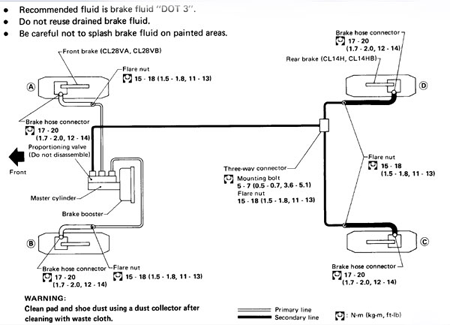
Bleed brakes in the following order: C, D, A, B (image from: Nissan Motor Company Factory Service Manual)
Procedure to Bleed Brake System[edit]
First, apply the brake pedal several times with the engine off to remove the vacuum built up in the booster. The pedal should feel firm after a few presses.
Ensure the master cylinder is full of fluid and keep it at least half full throughout the process.
⚠️ Note: If the fluid drops too low at any point, air may enter the system. You must restart the process if this happens.
⚠️ Caution: Never mix fluid types or reuse old fluid — this can damage brake system components.
Step-by-Step Bleeding Order[edit]
Begin with the Left Rear wheel, the farthest from the master cylinder. Then proceed in this order:
- Left Rear
- Right Rear
- Left Front
- Right Front
Bleeding Procedure[edit]
- Loosen the bleeder valve to break it free, then re-tighten slightly so it can be easily opened and closed.
- Place one end of a clear plastic hose on the bleeder valve and submerge the other end into a small container filled with fresh brake fluid.
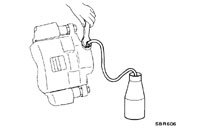
Example: Bleeder valve setup with tubing and fluid container.- Have an assistant pump the brakes several times to build pressure. On the final pump, they should hold the pedal down firmly.
- With the pedal held, open the bleeder valve slightly. Allow fluid and air bubbles to exit through the tube.
- When the fluid flow slows or the pedal reaches the floor, close the valve. Repeat until no air bubbles are seen in the fluid.
- Tighten the bleeder valve to 6.5 ft-lbs. Move on to the next wheel and repeat the procedure.
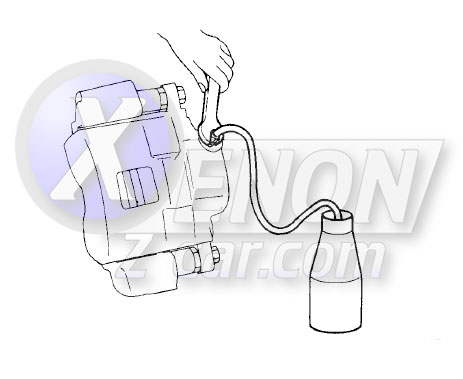
✅ Check the master cylinder often to ensure the fluid level doesn’t drop.
Hope this helps with Bleeding your braking system of air.
Sources Used[edit]
- 1984-1989 Nissan Factory Service Manual